

From 14 to 18 July 2025, Prague hosted the 9th annual conference of the Memory Studies Association (MSA), and MEMPOP project leaders Natalija Majsova and Vjeran Pavlaković were there to present the exciting research our project is undertaking, network with memory scholars from all over the world, attend as many panels and keynotes as possible, and of course enjoy exploring this beautiful and dynamic city.
Compared to last year’s MSA conference in Lima, Peru, the Prague edition was truly impressive in its size (1,400 participants!!) and the breadth of topics, panels, exhibitions, and additional activities. Although it was sometimes challenging to navigate the overwhelming program, the MEMPOP team members in Prague agreed that the conference was an excellent opportunity to advertise the project and get inspired by so many memory studies scholars.
The highlight of the conference program was of course our round table “Popularizing Remembrance: Populism, Pop Culture and Memory Politics”, which was kindly initiated by colleagues from the ERC project Memory and Populism from Below. Since we both share the same acronym, MEMPOP, we informally referred to this panel as “MEMPOP Squared”. Johana Wyss, the PI of our partner project, chaired the panel, which included her team members Astrea Nikolovska and Franz Graf, as well as Oliver Schmidtke, the lead researcher of European Memory Politics: Populism, Nationalism and the Challenges to a European Memory Culture. Natalija and Vjeran contributed to the discussion with an overview of the MEMPOP research interests, including our work on film festivals, popular music, murals and political graffiti, and especially the multimodal example of video games in the post-Yugoslav space. A rich discussion ensued between the members of all three projects about the interplay of populism and popular culture, which then expanded to include comments from the standing-room only audience. The common themes of all three projects became clear as the panelists and audience reflected upon contemporary events such as the Zagreb concert of Marko Perković Thompson, the student protests in Serbia, and the complex relationship between nationalism, populism, and popular culture.


Beyond the huge number of fascinating panels, the conference provided the opportunity to network with old colleagues and new acquaintances, generating ideas for future collaboration with the University of Regensburg, Grinnell College, Pompeu Fabra University, and University College London, among others. Vjeran participated in several Slow Memory events, as well as recruiting new members for the MSA Southeast European Regional Group. Natalija used the event as an opportunity to brainstorm ideas for the final MEMPOP conference that is to take place in Ljubljana in April 2026, by initiating conversations about decolonization, memory work, popular culture, and slow transformations with old and new friends from the memory-studies community. The keynote by Bulgarian author Georgi Gospodinov (Time Shelter) and the accompanying gala event created the perfect atmosphere for a more festive setting to meet and chat with colleagues beyond the often stuffy conference venues.

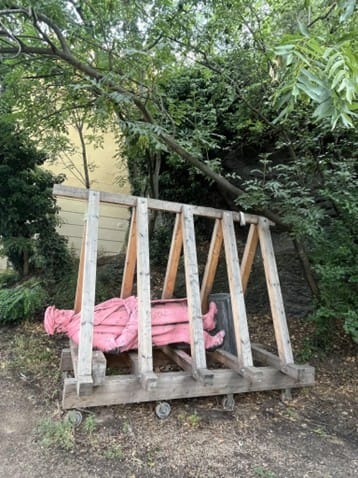

Finally, a visit to Prague could not have happened without some fieldwork in the city’s dense memoryscape. Taking inspiration from The Walking Journal (Slow Memory and MSA Prague 2025 edition] compiled (and designed) by Diana Salahieh, Vjeran explored some peripheral neighborhoods to track down a mural in support of Ukraine, as well as a fascinating mnemonic mural depicting the attack on Reinhard Heydrich (Operation Anthropoid) at the location that it took place in 1942. The mural provides a visual narrative of how the Czech resistance carried out the assassination, which is in contrast to the more traditional form of memorialization seen in the monument that is also nearby.


Leave a Reply