Owen Kohl
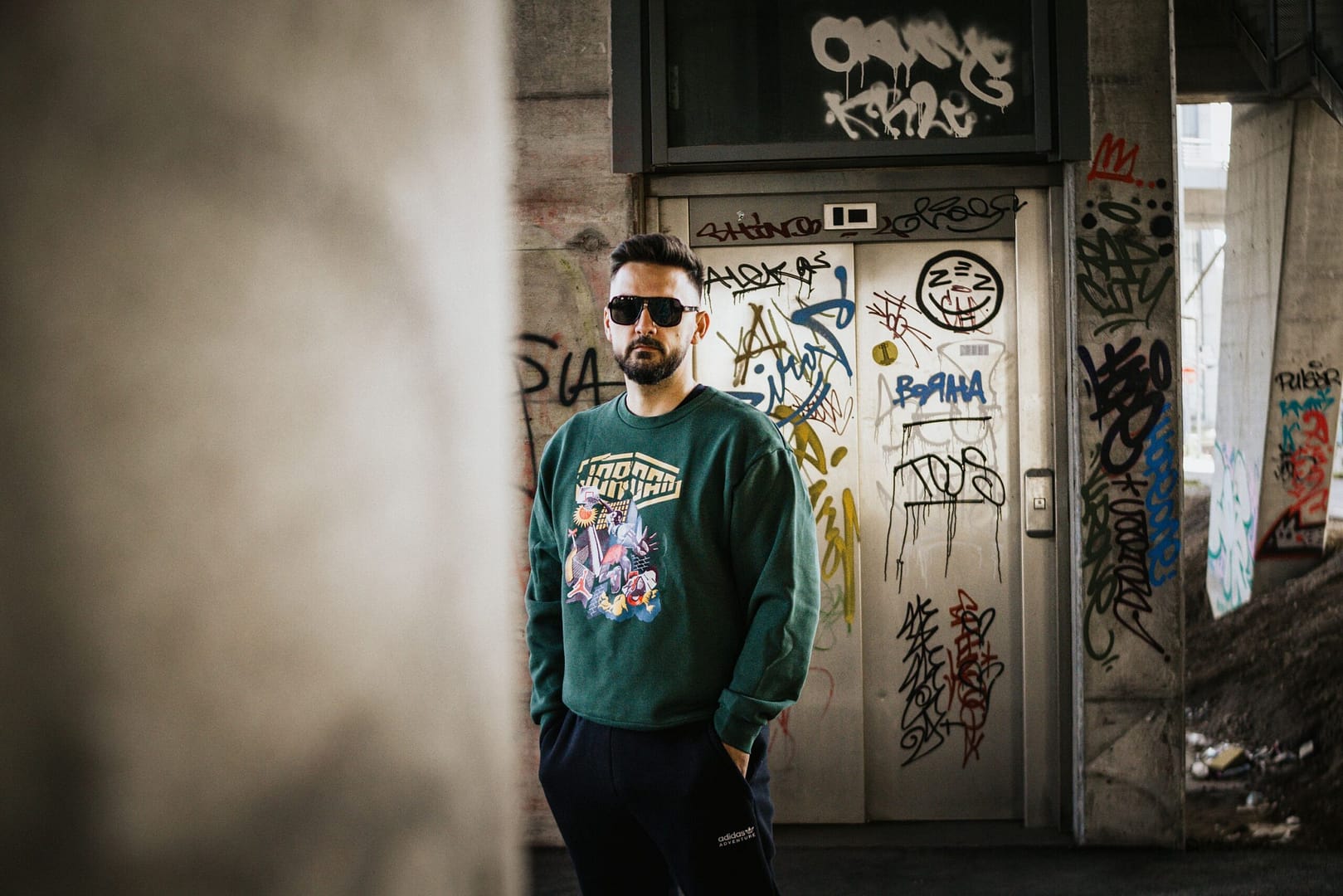
Back in September, I had the occasion to reconnect with Frenkie, one of Bosnia’s longtime leading rappers, who celebrated a 20-year retrospective of his graffiti-writing and music success at Sarajevo's Manifesto Gallery in May 2025. Before his first solo album was released, I saw Frenkie in 2003 provide back-up vocals for an erstwhile frequent collaborator at Zagreb’s “alternative” club Močvara (The Swamp) along the banks of the Sava River. Nearly a decade later, we spoke at a modest skate shop that he ran in Tuzla’s center. At the entrance to the store, a small exhibit behind glass could be seen proudly displaying mainly locally made hip-hop CDs - material evidence of the many occasions the northeast Bosnian city’s artists had embedded themselves in wider post-Yugoslav (often referred to as ‘domestic’) discographic circuits. Before the emergence of Pag’s Fresh Island and Belgrade’s Svi kao jedan (All as One) Festivals in the 2010s, Tuzla somewhat counter-intuitively laid claim to being the only annual domestic hip-hop festival in the region. Bosnia’s third-biggest city emerging as an important hip-hop capital was thanks in large part to the popularity of Frenkie and DJ Soul of Radio Kameleon’s FmJam Hip-Hop Show, which has since become a YouTube channel housing artists’ now classic and more recent videos.

After trading hellos and updates, we briefly discussed politics in the US, including at colleges and universities. The fallout from Charlie Kirk’s assassination, Jimmy Kimmel’s subsequent initial cancellation, and the idiosyncratic alliances emerging in Washington surrounding the Epstein Files were all top of mind early that morning. Frenkie generously answered my meandering questions.

What follows is the bulk of our hour-long conversation, including snapshots of Frenkie’s disc-, film-, and videography. A subsequent lyrics appendix houses translations of songs that we discuss most below.
Owen Kohl (OK): Not long ago, I read your article: “The Boat Is Sinking, But Music Is Still Being Played” [for Plenum.ba]. We have that same feeling among the professors. The boat is sinking, but we’re still teaching. A strange situation. Terrible. (Nedavno sam pročitao tvoj članak: “Brod tone, a muzika i dalje svira.” Imamo i taj osjećaj kod profesora. Brod tone, ali i dalje predajemo. Čudna situacija. Užasna.)
Frenkie (F): Yeah. It’s a little bit… It’s hard to explain, but you know, everything is losing purpose, especially here in the Balkans.
So for me, I was just thinking, some basic stuff that we did two years ago, for example: going on vacation, and making a picture of your food, of your hamburger, or whatever you’re eating…now it’s becoming uncomfortable to do that, because you know there are people starving there. And you feel like you’re doing something wrong. It’s a weird feeling.
Frenkie
We also have the protests in Serbia, which I mentioned in the column. I have a lot of friends there, musicians from the cultural scene and stuff like that. And they all say, “I don’t know. I feel uncomfortable having concerts in this time”, because they have protests against Vučić and stuff like that.
And of course, there’s a war in Gaza.
So for me, I was just thinking, some basic stuff that we did two years ago, for example: going on vacation, and making a picture of your food, of your hamburger, or whatever you’re eating…now it’s becoming uncomfortable to do that, because you know there are people starving there. And you feel like you’re doing something wrong. It’s a weird feeling. So I tried to explain that a little bit in that column. Everything is losing purpose, and it’s becoming very uncomfortable to go on with everyday life, knowing that a few hundred kilometers from here is like hell.
OK: I’m in the middle of Iowa, and it’s very rural. This is where I’m teaching now. This is my naive American perspective: We easily forget how close Palestine and Israel actually are to everything else in Europe. The distances aren’t so dramatic, where you are.
F: Yeah, it’s not even the geographic distance, but our history from the 1990s is also close. I remember the war, and I remember how it was. And because of this, I feel more empathetic to other conflicts. Whether Ukraine or Gaza, it doesn’t matter. I just couldn’t believe that in 2024 or 2025, that we still have wars. It sounds naive, but I thought we got over that concept. I thought we got smarter and more diplomatic and can fix things in different ways. But still, humanity is just… Somehow it fell into this trap, and new conflicts start all the time.
Especially in Bosnia, if you follow the politics and watch the news, war is [still] always present every day. We talk about war, and the war in the 90s, or maybe will there be war again? Will it start again? Kosovo is also in our neighborhood. So there’s always tension, and somehow we cannot escape that. We can’t escape talking about war, and remembering the war, and talking about eventual future wars. It’s really a fucked up situation.
OK: It’s different here, obviously, because we’re very naive about that history. This was a question I wanted to ask about “A Letter to Milan” (Pismo Milanu)…I wonder if you could take us backstage a little even more than the [connected documentary] video does? Because it seems like it’s really relevant to what we’re talking about… Sometimes I even use it with my students here. I show it to them. It seems very important to me that they see it. (Ponekad koristim čak i sa studentima tu. Pokažem im. Baš mi se čini da je bitno da oni gledaju to). I’m sorry for the awkward question, but you have this wonderful discussion about how you experienced that “coming to terms with the past” (Vergangenheitsbewältigung) in Germany. What was your thinking with Milan about this song? Why did you think of it as a three- or four-part series, including the aforementioned song, music video, and documentary short, A Letter; and the longer film, Border?
F: Well, first, I didn’t… We didn’t take it that serious. And we didn’t even know that it would become a documentary or this big song, which is mentioned all the time. Journalists ask me a lot about it.
Our goal was just to have an honest conversation and a dialogue between…well, it sounds big, but between Muslims and Serbs. Bosniaks and Serbs. To bring it to a basic human, personal level, like me talking to Milan. Because I felt back then – and it’s still that way today – that people just talk not to each other, but at each other. And they somehow miss the dialogue. They just say what they want to say, but they don’t listen to the other side. And they don’t accept their arguments and their feelings. Well, not feelings, but facts – what they’ve been through and stuff like that. So I just wanted to try to start an honest dialogue with a song. That was our idea.
Actually, Milan and I worked together on it. I wrote the lyrics, of course, because he’s not a rapper. But he gave some suggestions. And when I wrote something, I sent it to him, and he said, “Wow, this is really good. Maybe change this.” So I had an input from his side, because he’s been a peace activist for a long time. He worked with veterans from all sides. With Serbs, Muslims, and stuff like that. Even I had some workshops with them. And he worked with the youth. So he basically knows very well how the situation in the local small cities looks like.
So my idea was just to be honest, to say something, to try to put myself also in their shoes, and then to try to also make them see our perspective. That’s basically it.
You mentioned the thing about Germany, and how we visited the Dachau concentration camp. That was a really powerful experience for me when I was in school in Germany. And when we later recorded the documentary about the song, the guys who did the documentary later did a workshop with kids all across Bosnia. And they liked the idea that traveling helps a lot in those situations. Because, like I said in the interview, I saw in my class in Germany, when I was in 8th or 9th grade, I saw some of my friends became neo-Nazis, a little bit right-wing, fascists, and stuff like that, wearing those recognizable clothes back then in the 90s.
And then we had this visit and I saw how that affected them.
It’s different when you only hear about stuff like the Second World War, war crimes, and the Holocaust. But when you come to a place where that stuff happened, and when you see, when you enter the concentration camp, when you see the photos, when you see all that stuff, it affects you on a different level, of course.
Same goes, for example…for people from Serbia who come to Srebrenica, I remember when Marčelo came for the first time with his crew. They all know what happened, and they don’t even deny that stuff. But still, when they came to Potočari, and when they entered this big complex, when they felt the energy, and when they saw all that, you could see on their faces that they were shocked.
So the idea was like… Maybe after the song, to influence schools to organize trips like that, like we had in Germany. Of course, I don’t know if that happened – maybe some of them did. I know that a lot of youth from Serbia and Croatia come to Srebrenica to volunteer. There are some [school] camps that I also work with. So it’s a small step, but it’s also helping a lot, because nobody can be immune to that when you come and see that with your own eyes.
Coming back to the song, when we released it, and the video came out, I remember that it immediately went viral. But not viral like today with TikTok or stuff like that – back then it was everywhere on the news channels. Because it was the first time that a musician or a rapper talked about this topic this openly, and also I got a lot of great support.
But also I got a lot of backlash from my side — from Bosnians and from Muslims — saying that I was a traitor, that we should not talk to people who did war crimes — to Serbs and stuff like that. So it erupted into a big dialogue and discussion, and there was a lot that was — not all of it — constructive. There was also a lot of hate, but in the end, I think we were successful.
And we did a good thing, because I’m really proud of that song, and I think it was really brave of me. Now, at 43 years old, looking back, and thinking about what I said there: I was like, “Oh man, I’m not sure if I, today, would have the courage to say that stuff.” Because I’m wiser, and I’m older, and I know what it can kick off, and that I can have a lot of backlash and problems with it.
But back then I was younger, and more brave, I would say. So it’s one of my favorite songs, and one of the songs that I’m most proud of. I hope I answered.
Later as I matured and I got a little bit older and wiser, I realized how much power music has, and that there are different approaches to it like I said. [There’s] “Hajmo ih rušit’”, a punk attitude, saying what you want and that’s it. Or maybe you can also say what you like to say and present a point of view, but also leave the room for a dialogue, leave some room for people to connect. Not make people mad and pissed at you, but open the door for some conversation.
OK: Apropos, I have a question that’s sort of awkward, but it comes from an interview I remember. Maybe it was in [the magazine] Dani, many years ago; it was after the album Anti-Venom (Protuotrov). And I think you said something like after “Let’s Bring Them Down” (Hajmo ih rušit), you started to think more about storytelling. And that there’s the song “Nerko” that’s like the same message as the earlier hit, but in a softer tone.
Could you tell me about how you think about storytelling in rap, and its power to create the kinds of opportunities for “coming to terms with the past” (suočavanje sa prošlošću) or even just connections between friends across a border?
F: Yeah, well, it’s not even storytelling, it’s just that I became a little bit wiser, and I matured.
When I look back at my first albums and my first songs, for example “Hajmo ih rušit”, it’s a rap song, but it’s basically like a punk attitude, where I just say what I want, criticize who I want, and even curse some people, and say “fuck this” and “fuck that”. To me that’s like saying what you want and then slamming the door. And I just don’t give a fuck about the reaction and anything. I mean, it’s okay, it’s a punk attitude. You don’t care about what other people think. You just want to put your opinion out there, and who connects with it, connects; and who does not, fuck it.
But later as I matured and I got a little bit older and wiser, I realized how much power music has, and that there are different approaches to it like I said. [There’s] “Hajmo ih rušit”, a punk attitude, saying what you want and that’s it. Or maybe you can also say what you like to say and present a point of view, but also leave the room for a dialogue, leave some room for people to connect. Not make people mad and pissed at you, but open the door for some conversation. I explain it like this.
So this is the biggest difference between me on my first album and me on Protuotrov or Troyan (Troyanac), where “Pismo Milanu” is. I realized that it’s better to start a dialogue, to listen, to get some feedback and to leave some space and some room for an honest conversation. So that’s how I approached my later songs. And yeah, some of them are through storytelling and stuff like that.
But also when you listen, for example, to “Burn” (Gori), the reggae song, this has also almost got the same message, but more maybe on a global level. But still, it’s not like this punk attitude – just piss everybody off and leave the room or something like that. It just connects more with the people.
And yeah, that’s something that I changed in my music, not even like with a plan, but it just came naturally. I was growing and I was maturing and changing my approach to music and I saw that this is more effective.
I wanted to say something else, because I know how powerful music is. And I said earlier that one of my most favorite songs is “Pismo Milanu” and “Gori” and “Hajmo ih rušit”, because they talk about some important issues and they succeeded somehow to get to the people and to make the people think a little bit. They’re not like classical rap songs where you battle or represent lyrics, or talk about money and women and cars and stuff like that. It’s also nice. That’s part of hip-hop, too.
But I think that the most valuable songs…and the most quality comes from songs where you spark a conversation and spark a dialogue. When you listen to a song and you turn it off, and you say, “Wait a minute, I need to think a little bit about this. I need to research something.” It’s like a good movie or a documentary show.
I watched Narcos, and it was so good that I was feeling sorry for Pablo Escobar at the end. I was researching about his family, his son, and stuff like that. That’s how good the show was. It made me look to explore more about the topic. And that’s what I tried sometimes. And I succeed, I think, with some of my songs when I talk about politics and the situation in the Balkans.
Working with Nerko and Milan gave me a deeper view, and I could better analyze the mindset of people like that, like veterans. When you talk to them, most of them wouldn’t say “I fought for Bosnia” or “I fought for our president” or “I fought for this politician or that politician”. No. Most of them would say “I saw that war was starting and I wanted to defend my house and my family and my son and daughter and whatever”. When you approach it from that way, you see that most of them…a lot of those people are really brave, and I would say they are heroes.
OK: You definitely do. I’m, as you can tell, an avid listener. But for me, one of the most powerful is “Nerko”. It really is an incredible song.
F: One more example is “Teočak”. That’s a different topic. It’s not like war stuff. It’s about delinquents. It’s about criminals, young people who get on the wrong path and stuff like that. That’s also one of my favorite songs.
OK: It’s so powerful — just the beat and how it works with your lyrics.
F: It’s one of the rare moments where everything clicked together.
OK: It happens, I think, for you frequently. I’m not sure if any of these themes are too sensitive or anything like that. Don’t hesitate to let me know. Could you take us behind the scenes of “Nerko” and how you came to that idea?
F: Yeah, somehow, reporters don’t ask me much about it. Nerko is also a real character. He’s a friend of mine. He’s a war veteran. I worked with him and Milan together with some other veterans. Basically, that work inspired me to write a song about it.
Because the picture people sometimes have of veterans is that they are equal to war criminals, which is, of course, not true. Because most of those people, on all sides, approached and got into the army because of logical and normal reasons…for example, defending their families, defending their house and city, their wives and kids, and stuff like that. Of course, you cannot say nothing against that. That’s the most normal thing. I think I would do the same thing. There are, of course, a big part of them who went into war crimes, became criminals, and mafia and stuff like that.
But I would say the bigger part, the bigger percentage of the veterans, are normal people. Of course, I listened as a kid…growing up with my parents and listening, watching the news with them while the war was going on, and then hearing them talking about politics.
Working with Nerko and Milan gave me a deeper view, and I could better analyze the mindset of people like that, like veterans. When you talk to them, most of them wouldn’t say “I fought for Bosnia” or “I fought for our president” or “I fought for this politician or that politician”.
No. Most of them would say “I saw that war was starting and I wanted to defend my house and my family and my son and daughter and whatever”. When you approach it from that way, you see that most of them…a lot of those people are really brave, and I would say they are heroes. Of course, I’m thankful for their service and sacrifice and everything.
I wanted to bring closer to my listeners profiles like those war veterans. And I’m really glad and know that the song is very powerful because most of the veterans, they work together, they listen to that song and they all say “this kid sounds like he was with us on the front lines”. I’m really happy and proud that through talks with them, I could catch that and put it together in a song.
OK: There are these powerful lines like… “You can add a million more states/and it still isn’t worth as much as her fingernail” (Uz ovu državu možeš milion dodat’/ali to ne vrijedi kao u moje male nokat). For me, it really touches… I don’t know, maybe it’s just because I spent some time in the region, listening to people’s stories. It makes me emotional when I hear that.
I wanted to ask you about that line specifically and how… I notice how this often comes up in conversations in the United States, too, where we talk about “They” (oni). So, for example: “Frenk, you know who those people are/We weren’t important, we were pawns” (Frenka znaš koji su ti ljudi/Mi nismo bili bitni, bili smo pijuni). You make great use of this third-person plural. I guess it’s a naive question, but could you explain to an American audience who that “They” is?
F: In that case, I refer to the politicians, of course. I tried to explain that most of those veterans in Bosnia, of the Army of Bosnia and Herzegovina, after the war, they just came to that realization that they were just pawns, or just numbers on a sheet. Because of how the politicians treated them after the war — not only the politicians, but also the state.
Because after the war, they were basically like, “Ok, that’s it, guys. We don’t need you anymore. See you”. For example, Nerko, concretely, he’s like 98% disabled, because he was in the war and he got injured. And he also had PTSD and stuff like that. And for long, long years, he didn’t want to get the benefits that he deserved, because he’s a poor veteran, and on top of all of that, he’s disabled. So basically he had the right to a monthly income, some money for his service. But he didn’t want to get that, because he was thinking to himself, “No, I didn’t fight for this. And there are also many other soldiers that are even worse off than me. They can have it, but I’m not that guy.” So that’s what I somehow tried to explain, or tried to touch on, in those lines.
And this line that you said before about the nail of his daughter or son. It’s just a little bit preterano. How do you say?
OK: Like, exaggerated?
F: It’s a little bit over-exaggerated. But I just wanted to make clear that for those people, it’s not country in the first place. It’s their daughter or their son or their family.
…I cannot remember now detail for detail, but some of those were also maybe direct quotes from the soldiers. Or maybe I just put something of my own in it. But it could also be what I heard them say and then somehow put it into my lyrics and tried to make it rhyme and sound good.
Just one more thing. As a younger boy, I also read a lot, and one of my favorite writers in Bosnia was Marko Vešović. And he passed away a few years ago. And one of his biggest talents was that he just traveled Bosnia, even in wartime, and he listened to the people telling him stories. And he just focused really, really hard to remember as much as he can. And then he put that on paper. He went so far even to adopt their accent and write even grammatically wrong words just to make it as authentic as possible.
And I was always amazed by his talent and how he did it. And so I also implemented that a little bit in my raps. So I learned basically a little bit from him. So it’s just good, you know, to hear what the people say and to write this down. It’s enough. You don’t even need to put something more in and make it more spectacular. Life is stranger than fiction, people say. So it’s enough, you know, when you just take what you hear and try to implement it in a rap song or rap lyrics.
OK: I wanted to ask you some hip-hop questions, too. So when I reached out this summer, I noticed the [20th anniversary] gallery show [since the first album, Excellent CD (Odličan CD)] Congratulations, by the way! I guess it’s called Manifesto Gallery, right?
Some of the coverage made me think that — and it’s just a thought I’ve been having, you know, 10 years removed from when I was really living there and doing this research initially and speaking to a lot of artists. It seems like the relationship between the media (javnost) and the artists (izvođači) has changed a lot.
I mean, correct me if I’m wrong, but the coverage is more informed about what hip-hop is.
F: Yeah, yeah, yeah. They learned, they learned.
OK: Yeah, exactly. And not only that, but you know, there’s this emergence of all these great podcasts like yours [Manifest] and Galeb’s in Belgrade [Agelast], and also, you know, I think Khan’s [Ril tok] is really interesting in Zagreb. Do you have thoughts about all of this? I mean, what do you think of that change in media coverage, you know, from when you started as a rapper to now, 20 years later?
F: Yes… A few points are there. First, I mean, I grew up. I have a long career behind me, and I think it’s different now compared to my beginnings. Also, the media knows me and knows my work and follows it. You know, if I release a new album or new song, of course they will talk about it or write about it and publish it. Because I’m not a kid anymore [or] like a demo rapper. I’m an established musician.
So the second point is social media and this new age where we live also makes the media’s job easier. You know, they can see in real time what’s going on and they just release it on their websites or whatever.
And yeah, I would say the third point is they all learned [in the mean time]. They learned a lot about hip-hop and hip-hop culture and graffiti and stuff like that. So we grew together, I would say.
But for me today, [mass] media isn’t so important, you know, because I have an Instagram, I have TikTok, I have all those podcasts as you say. And I feel even more comfortable, you know, coming to a podcast like Khan’s, where I know that I’m talking to another rapper who knows a lot about hip-hop and rap and who knows my stuff and will not ask me the same three questions like every other, you know, journalist on local TV, because they don’t know rap as much or as good as Khan, of course.
So it’s even maybe better for me, or for other rappers, just to do like one or two, three podcasts where you can talk about stuff more deep and, you know, longer and explain everything. And our audience will see that anyway… They don’t watch the news or, you know, they don’t watch TV.
So it changed a lot. Comparing it to before…I think now it’s much easier for artists to reach their crowd and to promote work, because they’re not dependent on the classical media, you know, mainstream media… And even releasing music is, of course, much easier. Upload it everywhere and people can hear it. [You can have it with] a click…no more CDs, no more vinyl and stuff like that. You don’t have to go anywhere. It’s in your phone.
And yeah, those are some of the benefits of this time that we’re living now.
You know, on TikTok you have a lot of stupid stuff there and I just, you know, do as much as I feel comfortable [with]. I think that, “okay, this is me, and if I go further than that, then this is not feeling comfortable for me.” So I will stop here and adopt these methods and these channels, and that’s it.
OK: This is a sort of related question, but, you know, you’ve mastered a variety of different media forms… You’ve written op-eds, you’ve published documentaries and now the autobiography, countless songs, and TikTok… But from our conversation even today, it’s clear how much you respect more traditional media like books and graffiti writing. And so I wonder how you think about the kind of benefits and drawbacks of the new technology versus keeping the old alive, including through TikTok, like through your tutorial videos on graffiti writing. Do you have any thoughts about that? How you relate to both old and new media?
F: Well, I actually really didn’t analyze that so much. I know, of course, that regarding my audience, most of them are on social media, but also I am 43 and I know that a lot of listeners are my generation. Some are a little bit older and even older than that. So I know that it’s like spread. Some of them are on, I don’t know, Instagram and Facebook and stuff like that. Others, the younger ones, are on TikTok. And of course, there is some target audience also watching TV.
So I know that when I released like a new album, I tried to cover all of it or [as much] as possible, knowing that some people would, you know, watch me here, the other ones there. So yeah…I just go with the flow.
I basically see how the media is changing and how everything is switching online.
And TV. I don’t know. I watch TV only if I want to watch a game — Bosnia play or something like that. Because everything else you get from your computer and online, or a cell phone. And I think that it will just continue to go this way and that the mainstream media will…
You see it already here in the Balkans. All the channels also have TikTok accounts where they put their short videos. And basically TikTok became also like a source for information and for news.
So it’s funny to watch, and I just follow the trend as far as I feel comfortable. You know, on TikTok you have a lot of stupid stuff there and I just, you know, do as much as I feel comfortable [with]. I think that, “okay, this is me, and if I go further than that, then this is not feeling comfortable for me.” So I will stop here and adopt these methods and these channels, and that’s it.
OK: There was one question that I guess is also sort of related. You’ve also collaborated with a wide array of not only artists, but this was always something that I found difficult to explain — the different ways that artists support their work in the region… So, for example, If I’m correct, Steps (Koraci), the book, was supported by Goethe Institute, right?
F: Yeah.
OK: And then Red Bull, on another side of the spectrum, has been a big sponsor of various films?
F: Yeah, exactly.
OK: Could you talk about this? Could you talk about that specific landscape of sponsorship in BiH or, you know, across domestic spaces? What it looks like, how it’s different than other hip-hop scenes?
F: That also changed a lot. At the start, we had big problems and nobody wanted to sponsor [or] work with us. No big brands, nothing.
Normally the support should come from our, you know, city or from the state and from the Ministry of Culture. But you don’t get any help from them. You know they don’t care about you. So you’re basically…when you live in a country like Bosnia, you can try to do it all alone or look who is interested in working with you… I mean, of course, the commercial sponsors.
I remember my relationship with Red Bull started through a fight with them, because we had a little festival in Tuzla that we organized. And in the first year they wanted to sponsor us, and they just gave us like, I don’t know, ten cartons of Red Bull.
And I mentioned that in one interview, you know, not even naming them, but saying, “it’s hard for us to get sponsors and if you get some, they just give us some free stuff and that’s it. And they don’t even want to support us with money”… And the boss of Red Bull in Bosnia read that and said, “What the fuck is this guy talking? Call him! Let’s talk with him and stop this!” You know, that’s how our relationship started. And that’s also like a long, long partnership which grew.
And it became like a friendship, because Red Bull is like a specific brand. It also has a different approach to marketing and stuff like that. They are more urban, I would say, than other mainstream brands — not to name any — but they are more easy to work with.
And they don’t, you know, have like — how would I say? — they don’t try to censor you. I never heard from them, “Please, can you talk about that?” Or: “Please lay off here. And can you please talk more about this?” And that’s one of the most important things for me when I work with some brands… I have the freedom to say what I want in my songs, in my interviews, and stuff like that. And if we can agree on that, then we can talk about, you know, collaborations…
Goethe-Institut was also like a pretty natural collaboration because I lived in Germany. I did some workshops for them. And then our partnerships grew, and they sponsored two of my books. Koraci was one of them. They basically just, you know, paid [for] the print[ing], and the other one was Lack – Made in Bosnia. That’s about graffiti. They also sponsored that. But we also did workshops with them, we played concerts for them. We, you know, promoted their festivals and whatever they did in Bosnia.
So yeah, it was very, very easy, and I guess brands recognize you when you reach a level. Then they say: “Okay, this guy’s working good, he’s a professional… You know you can count on him when he says something and he gives you [his] word. He will finish it, and he will do it.” It comes with the years when they just realize that working with me is also good for them and vice versa. So yeah, it was a big help for us.
Coming back to Red Bull: we did three albums in Berlin, Tokyo, and in Los Angeles, That was in Red Bull Studios. And they, of course, were a big, big help for us…recording those albums and organizing the trips and all that. And also they were our sponsors [for] some videos and some concerts and stuff like that. Not only that, they are also investing in tourism, in Bosnia, for example. You have this jump [diving competition] in Mostar, from the Old Bridge. They have massive events in winter — skiing, snowboarding, and stuff like that.
So normally the support should come from our, you know, city or from the state and from the Ministry of Culture. But you don’t get any help from them. You know they don’t care about you. So you’re basically…when you live in a country like Bosnia, you can try to do it all alone or look who is interested in working with you… I mean, of course, the commercial sponsors.
And Red Bull…like I said, we are friends today because we’ve worked so long together and we know each other, and we just function perfectly together.
So yeah, it also took a long time to get to this point, but I’m of course very thankful for all that they did. And like I said, they not only helped my career, but they helped the hip-hop scene in Bosnia, because they also had like MC Battles, numerous festivals — you know, documentaries and stuff like that. So they are a part of the hip-hop scene, not just like a sponsor of Frenkie. And further even, like I said, the Mostar jump [diving competitions], ski festivals and events — so basically, they are also promoting Bosnia. And also pumping in a lot of money here.
So it’s basically good to have them.
OK: Frenkie… I wanted to ask you as well — just thinking about navigating the world of sponsors and politics — about “Viva La Palestina.”
F: Yeah.
OK: Some of the most powerful lines there I think relate to “never again” (nikada više) and how that principle has been betrayed. Also, references to Sarajevo Purim and the references to various leading critical voices. Roger Waters, I think, comes up, and Norman Finkelstein…
F: Gideon Levy.
But it’s a difference between, you know, criticizing like a politician or a regime and, you know, canceling a booking for Israeli tourists. You don’t know if he’s like pro-Netanyahu or against the war. Maybe he fled Israel because he couldn’t watch it anymore, and maybe he’s like an anti-war activist.
You know, that’s a very big, important, difference to make. And that’s also what I tried to explain in my verse in that song. The target or the main point of criticism is, of course, the politicians. They [call] the shots, they give the orders, so it’s their responsibility and they should be, you know, arrested and brought to justice and to The Hague.
Let them share a cell with Karadžić and Mladić. I would be very happy if that happened.
OK: Yeah, exactly… One of the last times I was in Sarajevo, I was heartened by the fact — and this was over a year and a half ago now — I was heartened by the fact, in some ways maybe unsurprisingly, that people were much more open to talking about what was happening in Gaza. So I’m curious about the kind of reactions that you’ve had to “Viva la Palestina” and the importance that you see in really expanding that notion of “never again”…
F: Well, I would say overwhelmingly the reactions were very positive, because like I said, Bosnia and the Balkans are empathetic to anyone who goes through war and conflict and stuff like that, because we’ve been through it. And not just one time, you know — [there was the] Second World War… So, there’s basically like a consensus in Bosnia that, of course, we support Palestine. And we condemn those war crimes from Israel and from Netanyahu’s regime.
For me, it was important. I talked about Palestine even on the song “Identity” (“Identitet“) on my last album Manifest. So people basically knew where I stand on that topic. But still, I wanted to be as clear as possible and to do a special song on that topic.
And you mentioned all the lyrics and people I mentioned. I tried to present that as not like a Muslim-Jewish thing. I tried to present it as a human thing, you know. And that’s why I named all that stuff from the past, like Sarajevo Purim, the Haggadah. Because it’s important to see that this is not like a conflict between Jews and Muslims. This is just a genocide committed by Israel right now. And scholars who know about genocide say it is one. So basically we don’t have to [debate] it anymore. We don’t have to talk about [whether it] is one or not. People smarter than me and you think it is. So I will accept that, okay?
I just also wanted to remind the listeners and tell them you have Jewish activists, Jewish singers, Jewish journalists who also are saying the same thing as me. Because it’s a very, very thin line between criticism and anti-Semitism, you know…
Because Israelis right now have their ugled (reputation) — their reputation is like shattered. People cancel their bookings, people don’t want them in their restaurants, in their hotels, throughout the whole Europe, you know. And that’s of course mainly because of Netanyahu and all the war crimes going on.
But it’s a difference between, you know, criticizing like a politician or a regime and, you know, canceling a booking for Israeli tourists. You don’t know if he’s like pro-Netanyahu or against the war. Maybe he fled Israel because he couldn’t watch it anymore, and maybe he’s like an anti-war activist.
You know, that’s a very big, important difference to make. And that’s also what I tried to explain in my verse in that song. The target or the main point of criticism is, of course, the politicians. They [call] the shots, they give the orders, so it’s their responsibility and they should be, you know, arrested and brought to justice and to The Hague.
Let them share a cell with Karadžić and Mladić. I would be very happy if that happened. We will see, you know.
OK: Things are changing dramatically, right? I mean, I think… Just even in the US…
F: Took a long time, unfortunately. I’m also happy to see that, you know… Change is going on.
I also lived in Germany. I follow the German media and the situation in Germany is even worse, you know.
It’s also changing, but the Germans, you know, because of the Holocaust…Adolf Hitler…all the war crimes that they have in their past… They are so careful. They are afraid to say anything about Israel or politicians there, so it’s really messed up. And they were the ones who said, you know, they started “never again”…
And I’m asking you, what does “never again” mean? Is it just “never again” for Jewish people or for everybody, you know? If it’s for everybody, then we already passed that, and we did it again unfortunately. Not even [only] now with Gaza, but with, you know, Ukraine, with Bosnia… So, it’s sad.
Note: the transcript above was lightly edited for the sake of reading clarity.
When the main part of our conversation ended, we exchanged a few additional references like Atshan and Galor’s The Moral Triangle and Ušić’s Zidovi pamte. I updated Frenkie on my long-delayed publication plans and hopes. We promised to stay in contact moving forward, including about a planned study-abroad excursion to Sarajevo. I thanked him profusely and leapt back into a busy teaching schedule.

Leave a Reply