

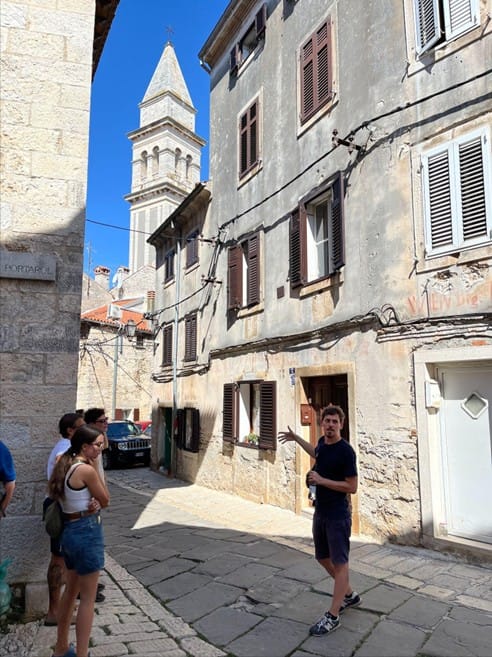
On 13 August 2025, MEMPOP researcher Eric Ušić led a dynamic cultural history tour through Vodnjan, using the town’s uniquely preserved graffitiscape as the inspiration for discussing Istria’s multilayered past, fluid identities, language policies, and contemporary understandings of antifascism. Tour participants had the chance to explore this unique heritage up close and, by deciphering the texts, uncover the intricate story of Istria’s 20th century, learning about key events and protagonists of the region’s antifascist past and the complex postwar reality.

One of the tour sites was a graffit honouring Joakim Rakovac, a central figure of the Istrian antifascist resistance movement in WW2. This site represents a particular example of the linguistic fluidity of Vodnjan’s graffitiscape, where the hybrid Italo-Croatian cultural reality of the region overlaps in a single text, transforming Joakim Rakovac into Gioachino Racovaz. The inscription was a visual prompt for a broader overview of Istria’s post-WW1 history, the Italianization policy and repressions by the Italian Fascist regime, as well as the history and significance of the Istrian People’s Liberation Movement (NOP).

Another important site was an inscription dedicated to Vladimir Gortan, a pre-WW2 Istrian antifascist and activist of the organization TIGR (Trieste-Istria-Gorizia-Rijeka). Gortan is one of the most important figures and symbols of Istrian antifascism, and his death in 1929 – the result of a death sentence issued by the Italian state – stands as one of the most significant events of the interwar period in Istria. Through a close reading of the graffit, the long and broader history of Istrian antifascism was explained and contextualized.
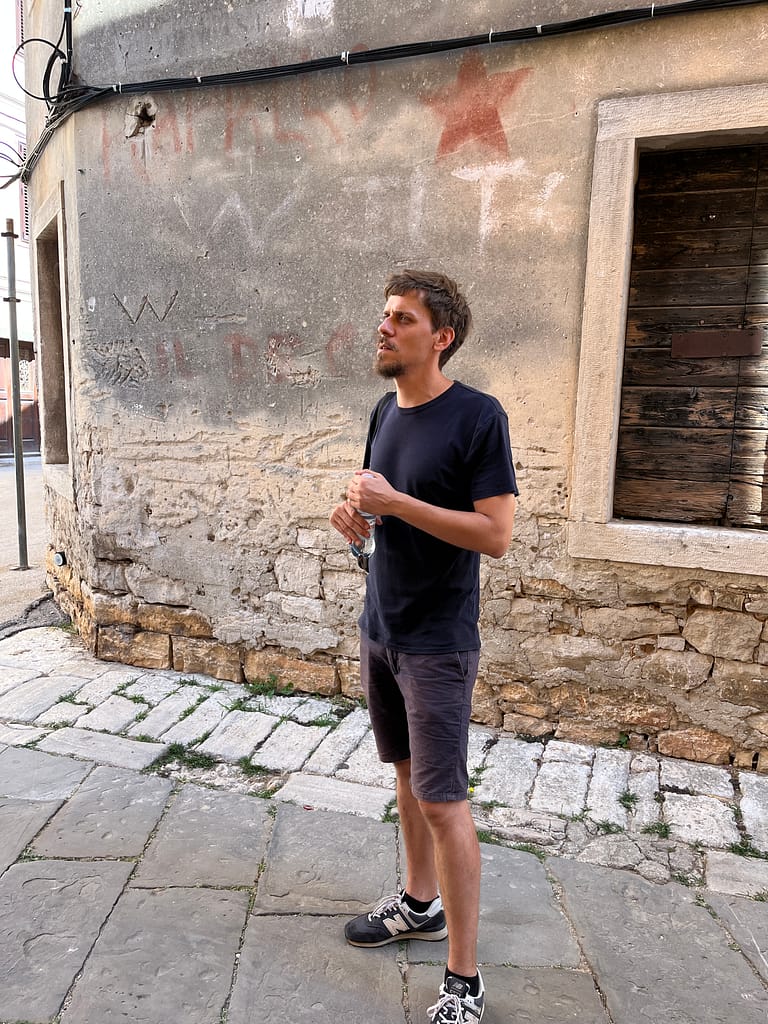
The exploration of Vodnjan’s graffitiscape was a chance to learn about the main protagonists of the Yugoslav NOP and socialist revolution – such as Tito, the main symbolic element of the whole graffitiscape – and to learn about the various techniques and kinds of materials used in this subversive (and subsequently state-sponsored) interventions in public space. By reading the walls, participants were also introduced to the young activists who had written the graffiti during and after the war, along with their experiences and memories, with Eric drawing on his extensive historical, visual and ethnographical study Zidovi pamte (The Walls Remember, 2024).
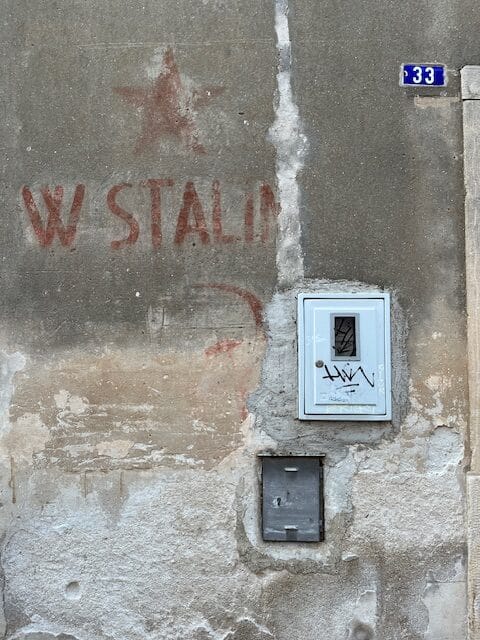
The complicated history of Istrian borders and post-war negotiations were explained through the traces of political slogans still visible in Vodnjan, such as those claiming the city of Trieste, expressing the will of the people to live in Yugoslavia, or rejecting the post-WW1 Rapallo Treaty from 1920. Through the analysis and interpretation of certain inscriptions – such as the one dedicated to the Italian Partisan battalion Pino Budicin – attention was also given to the contributions and positions of local Italian communists and antifascists, as well as to the heterogeneous and tense national situation in Istria, which led to the mass departure of local Italians after the war. In addition, the still-preserved graffiti dedicated to Stalin prompted discussion on the relationship between Yugoslavia and the Soviet Union, their split, and its consequences.
Overall, more than just a story about graffiti, the walk was an encounter with a unique memory landscape, in which walls, streets, and everyday spaces act as unofficial monuments and quiet reminders to the ideals, struggles, and authentic voices of the past. Though faded over the years, these antifascist, pro-Yugoslav, and communist messages offer a different, innovative way of reading, interpreting and understanding history: not through institutional archives and museums, but through worn façades and overlooked corners of everyday space. The tour sought to show how graffiti can function as grassroots open-air archives, preserving and conveying authentic fragments of collective memories.
The tour was organized by the Vodnjan Tourism Office, enabling scholars and researchers to present their work to a broader public.


Leave a Reply